

Generative AI is Degenerative for Our Planet
Everything you need to know about AI and the environment

This is the first instalment of “Ten Reasons to Resist AI: A series of AI explainers for the left,” covering AI and the environment. You can read the full series here.
In backyards across the United States, towering edifices loom large: warehouses spanning dozens of football fields, filled with rows and rows of refrigerator-sized computers, and miles of high-voltage electrical wiring. Picture the human-harvesting machines from The Matrix, remove all the goop, swap out the human-batteries for dead dinosaurs, and you’re not far off.

Data centers have existed since the advent of digital computing in the 1940s, but the expansion of generative AI systems such as ChatGPT, Google Gemini and Claude have astronomically increased their size and number. Data centers are also the source of AI’s most catastrophic environmental consequences, both atmospheric and local. The computing power inside of these hulking facilities is harnessed for the energy-intensive processes of “training” and “inference.”
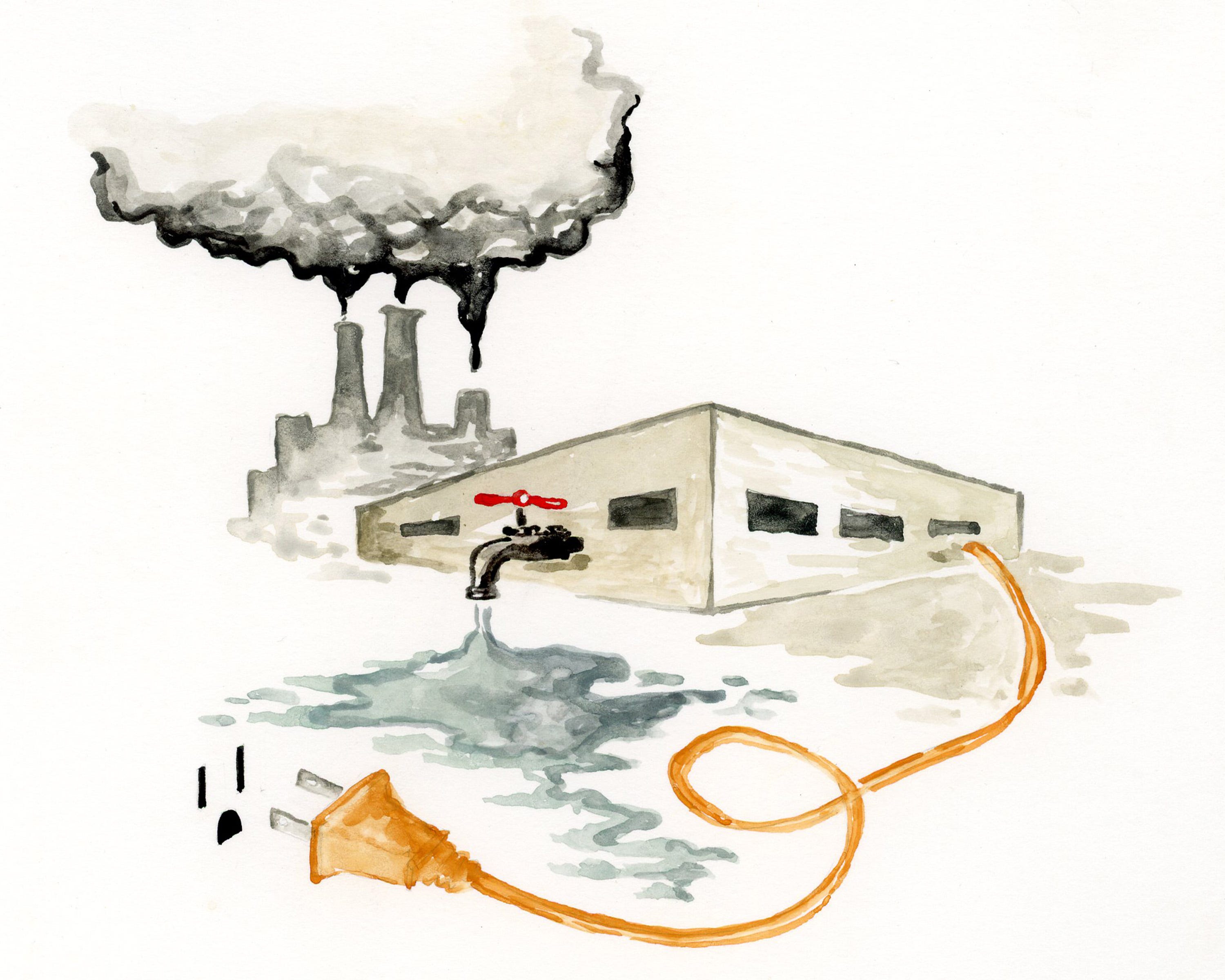
Understanding generative AI “training” and “inference”
Before a generative AI system can write your college essay, or tell you what outfit to wear in the morning, it has to be trained. First, software developers upload files containing a random configuration of “training data” to a data center, usually scraped from the internet, social media platforms, purchased from data brokers or illegally pirated. Training data might include text, images, videos, medical records, music or art.
Then the training begins. The AI is fed a minuscule piece of the training data and prompted to offer a prediction about what should come next. Perhaps it’s asked to complete a sentence or generate a simple image corresponding to a passage of words. The untrained AI will invariably generate nonsense, but it learns what not to do and adjusts accordingly.1 This process is repeated trillions of times, using tens of thousands of those fridge-sized computers continuously for weeks until the AI has enough information to simulate “intelligence.” After an AI is sufficiently trained, it is compressed onto a file of numbers small enough to fit on an external hard drive, which is distributed to another data center and made available to users. (A more detailed description of AI training can be found here.)
Our AI is trained! AI-generated recipes abound! But we’re not done yet. Now it’s time for the second energy-intensive process: “inference.” Every time a user prompts the AI, it produces units of information called “tokens.” A token might be a small square of pixels in a larger image, or a single word of an essay. Inference, the process of combining tokens to answer a prompt, is how an AI simulates thinking — and it’s an energy-intensive form of thought. Fabricating a college essay produces approximately five thousand tokens, consuming the equivalent electricity of running a microwave for three minutes. More complex prompts — such as image or video generation — require an increase in computing power and subsequent energy use.
The trick is that whenever an AI is prompted and a token is produced, this new data is captured and stored for the next round of training. Tech companies are never content with one model; they are constantly looking to update their product. Whenever individuals use generative AI, they provide a steady stream of new, valuable data. In other words, they feed the machine.
An earnest plea: As corporate media capitulates to the techno-fascists and welcomes AI into the newsroom, independent journalism has never been more important. I spent five months researching and writing this series (largely unpaid) because I wanted to learn, and writing is how I process information, but I could really use your support.
If you’re able to contribute $5/month, paid subscriptions help sustain this work. As a token of my appreciation, I have a few extra treats that will be sent directly to your inbox. Free subscriptions and sharing with friends are also incredibly helpful, and I appreciate you all!
The atmospheric consequences of AI
As a generative AI model is trained and used and re-trained and used again, the computers churn along and metric tons of carbon emissions exude from data centers. A single AI data center uses the same amount of energy as 100,000 homes, and the largest ones under construction today will consume 20 times more, equivalent to more than half of all homes in New York City. A Lincoln Institute study found that one Meta data center in Louisiana will require twice as much power as the entire city of New Orleans, while another data center planned in Wyoming will consume more electricity than every home in the state combined.
Because data centers are predominantly powered by gas, with some coal mixed in, this translates to a substantial bump in carbon emissions. Tech companies are not only stressing the existing power grid, but also building new fossil fuel plants alongside their data centers. For example, Meta is building three gas-fired power plants to supply its Louisiana data center and Oracle recently announced that its 1.4 gigawatt data center will be 100% fossil-fuelled.
On a global scale, MIT researchers estimate that in 2026, electricity consumption from data centers will approach 1,050 terawatt-hours, which, if data centers were a nation, would make them fifth in global electricity usage, after Japan and before Russia. A significant percentage of this energy is consumed during AI-training. These companies release new models every few weeks, requiring another round of training and another batch of emissions. But it’s not just training: Each ChatGPT query consumes five times more electricity than a simple web search.
Data centers are proliferating faster in the U.S. than anywhere else in the world — in fact, the U.S. is home to the majority of global data center growth. This means that the country with the greatest historic contribution to the climate crisis yet again finds itself on the frontier of a new extractive industry. A study by the Center for Biological Diversity found that by 2035, data centers in the U.S. will account for roughly the same amount of carbon emissions as all of Italy.
Data centers are not the only industry causing a growth in carbon emissions. While energy demand from heating, cooling and electric vehicles are also increasing, climate analyst Ketan Joshi argues that these things keep you alive in the winter and get you around town, whereas “it’s not clear what data centers are really for.” In the past, corporations sacrificed our planet for agriculture, heating and transportation; now they sacrifice our planet so that teenagers can sext a robot. (Yes, the most frequent chatbot use by minors is sexual or romantic roleplay… Don’t worry: I’m covering this later in the series.)
Poisoning air and draining reservoirs
In addition to exacerbating the climate crisis, data centers also have catastrophic local environmental effects. For example, xAI (owned by Elon Musk) built a gas-powered data center known as “Colossus” in Boxtown, a Black neighborhood in Memphis, to power the infamously racist chatbot Grok. Colossus and hundreds of data centers like it are reliant on diesel generators that spew nitrogen dioxide, particulate matter and other carcinogens into the air. Less than two years after being built, emergency visits for asthma spiked by 9 percent in Boxtown, likely due to pollution from the xAI gas plant. It is no coincidence that xAI chose a Black neighborhood to build its data center — Black and Indigenous communities historically harmed by environmental racism are yet again disproportionately subjected to a toxic industry.
This environmental injustice is compounded by the economic burdens of AI infrastructure. Data centers often require significant expansion of electricity transmission lines. Rather than tech corporations funding this infrastructure, they are making behind-closed-doors deals with local regulators, offloading costs to local people living near data centers who are seeing utility rate hikes at unprecedented levels across the country.

Data centers are also intensifying an already-dire water crisis — each time an AI is trained, or a query is made, a great deal of water is consumed. Chilled water absorbs the heat radiating from computing hardware inside of data centers, then evaporates, leaving the local water supply stream. This water is typically drawn from local reservoirs, straining municipal water supplies and disrupting ecosystems. A 100-word ChatGPT prompt equates to roughly one bottle of water. Data center-burdened communities have reported their taps running completely dry in the months after data center construction.
On a wider scale, the University of Houston found that data centers in Texas used 49 billion gallons of water in 2025, with an expected eightfold increase by 2030. A mid-sized AI data center requires about the same amount of water as a small town, while the larger ones consume roughly 5 million gallons daily, the same amount as a city of 50,000. A Meta data center in Newton County, Georgia uses roughly 10% of the entire county’s water supply, and a Bloomberg analysis found that about two-thirds of data centers built in the past three years were located in water-scarce regions. Another way of comprehending this scale: Current data centers demand more water than the entire global water bottle industry.
Beyond the water use, carbon emissions and local carcinogens, the computers powering data centers also require raw materials to manufacture, which involve extractive mining processes that have their own devastating environmental and human impact. Rare earth metals are mined and processed in China; lithium from Chile and Bolivia; uranium in Arizona; cobalt from the Democratic Republic of Congo.
Kindred spirits: Big Tech and the fossil fuel industry
So who’s to blame for the environmental consequences of AI? Is it individual consumers (“users”) or the tech overlords? The latter would certainly like you to pin all the blame on the former. In August, Google became the first company to publish statistics about the climate impact of its generative AI tool, claiming that each query is roughly equivalent to the energy use of streaming TV for nine seconds. There’s a few reasons why this statistic is misleading, which I’ll let you read about here, but their motives are clear: Tech companies are focusing rigidly on individual consumption to distract from the system-wide impact of generative AI (on which they have the data on but refuse to publicize). They are borrowing this tactic directly from fossil fuel companies and their “carbon footprint” invention, which shifts blame onto individual consumers rather than the real climate criminals: Google, Exxon, Amazon, Shell, OpenAI, BP (the list goes on).
Big Tech has an intimate relationship with fossil fuel companies: They are aligned on their mission of endless growth and each have something the other industry needs. Fossil fuel companies need new industries to sell their gas to, and tech companies need energy for their data centers.
A few years ago in a different political climate, as tech companies made bold climate pledges, the fossil fuel industry faced the prospect of declining coal and gas consumption. But today, these same companies are brazenly backtracking, signing monumental deals with fossil fuel companies to power their data centers. “It’s not like they halfass-ed it, but didn’t do a good job,” said Joshi, who reports on environmental data from tech companies. “They have very aggressively gone in the exact wrong direction.”
But the relationship between Big Tech and fossil fuels is even more pernicious. One of the few applications of AI that seems to work as intended is digital software that identifies fossil fuel reserves and makes extraction more efficient. AI models developed by Google, Amazon and Microsoft are able to locate previously inaccessible deposits of oil and gas, and have signed deals with Exxon and Chevron. When faced with backlash, tech companies shroud their failures with the narrative: ‘well it’s fine, because AI will solve our climate problems.’
There is absolutely no evidence that AI can help humanity solve the climate crisis, nor do we have any reason to believe that tech companies will prioritize climate action. Joshi compares this to how tech companies formerly hyped-up carbon capture and storage as a climate solution, using glittering greenwashed infographics, but when you dig into the hard numbers — which Joshi did — you find that a fraction of a percentage of emissions were actually mitigated.
“I suspect that exactly the same dynamic is going on with the way Big Tech is talking about AI. A lot of pictures, a lot of claims, a lot of nice stories in a glossy PDF... I suspect that it’s a tiny, tiny fraction of what’s going on,” said Joshi.
Local communities rising up
There is no doubt who our adversaries are: tech corporations and their fossil fuel co-conspirators. And while the environmental consequences of AI are grim, we are not powerless in the face of these behemoths. Across the U.S., communities are rising up against those looming figures in their backyards, unplugging data centers. A recent report found that local organizing victories that stopped or delayed data centers cost tech companies $156 billion in 2025. At least 142 groups in 24 states are actively organizing against data centers — you can read about some of them here. And if you’re fed up with AI and its environmental harms too, I’m betting there’s a data center being planned near you…
Bibliography:
MIT News, “Explained: Generative AI’s Environmental Impact,” by Adam Zewe. (Source)
The Associated Press, “Anthropic to pay authors $1.5B to settle lawsuit over pirated chatbot training material.” (Source)
The New Yorker, “Inside the Data Centers That Train A.I. and Drain the Electrical Grid,” by Stephen Witt. (Source)
The International Energy Agency, “Energy and AI: Executive Summary.” (Source)
Lincoln Institute of Land Policy, “Data Drain: The Land and Water Impacts of the AI Boom,” by Jon Gorey. (Source)
Ketan Joshi, “Big tech’s selective disclosure masks AI’s real climate impact.” (Source)
The Nation, “Generative AI is a Climate Disaster,” by Paris Marx. (Source)
Center for Biological Diversity, “How the AI Boom Threatens to Entrench Fossil Fuels and Compromise Climate Goals.” (Source)
Aura, “Kids and AI: Aura Finds Kids Turning to AI in Disturbing Ways.” (Source)
The Washington Post, “A bottle of water per email: the hidden environmental costs of using AI chatbots,” by Pranshu Verma and Shelly Tan. (Source)
The New York Times, “Their Water Taps Ran Dry When Meta Built Next Door,” by Eli Tan. (Source)
Houston Advanced Research Center “Powering Texas’ Digital Economy: Data Centers and the Future of the Grid.” (Source)
E-Flux “Eating the Future: The Metabolic Logic of AI Slop” by Kate Crawford. (Source)
The Guardian “Big oil coined ‘carbon footprints’ to blame us for their greed. Keep them on the hook,” by Rebecca Solnit. (Source)
A process also known as “machine learning.”
This report is devastating! Everyone should know.