


This is the seventh installment of “Ten Reasons to Resist AI: A series of AI explainers for the left,” covering AI and art/music. You can read the full series here.
I have to confess something. A couple years ago, before I had done much learning about AI, I wrote a Substack essay about my childhood fascination with ants. I finished a draft and started searching for a creative commons photo to pair with it. Nothing seemed quite right. So I went to Substack’s “Generate Image” feature and was prompted with “Describe what you want to create.” I typed in: “Giant ant stomping on Donald Trump.” Poof: Dozens of AI-generated images appeared. Many of them were bad, distorted, outright slop. But I was in a rush and eventually I found something that I thought was good enough. I hit publish.
I share this story not to self-flagellate, but to demonstrate that one’s analysis — and more importantly, one’s actions — may change, indeed ought to change. In a world where efficiency is virtue, and self-debasing shortcuts are more accessible than ever, succumbing to the urge of frictionlessness is not an aberration, but the intended cultural norm. The antidote is to develop firewalls against AI in our daily lives, to de-program our brains, to step back and slow down, and to bring others along with us.
Art and music — pure forms of human expression that cannot be captured by synthetic machines — offer a haven to do just that.
But these mediums are under attack by tech companies building AI products to appropriate art and mimic music, endeavors motivated by unadulterated greed and deliberate disdain for craftspeople. This isn’t mere conjecture. The tech oligarchs proudly state their intentions. Creative jobs “shouldn’t have been there in the first place,” said Mira Murati, chief technology officer at OpenAI, developer of the AI image generator Dall-E. “It’s not really enjoyable to make music now,” said Mikey Shulman, founder of Suno, the largest AI music company.
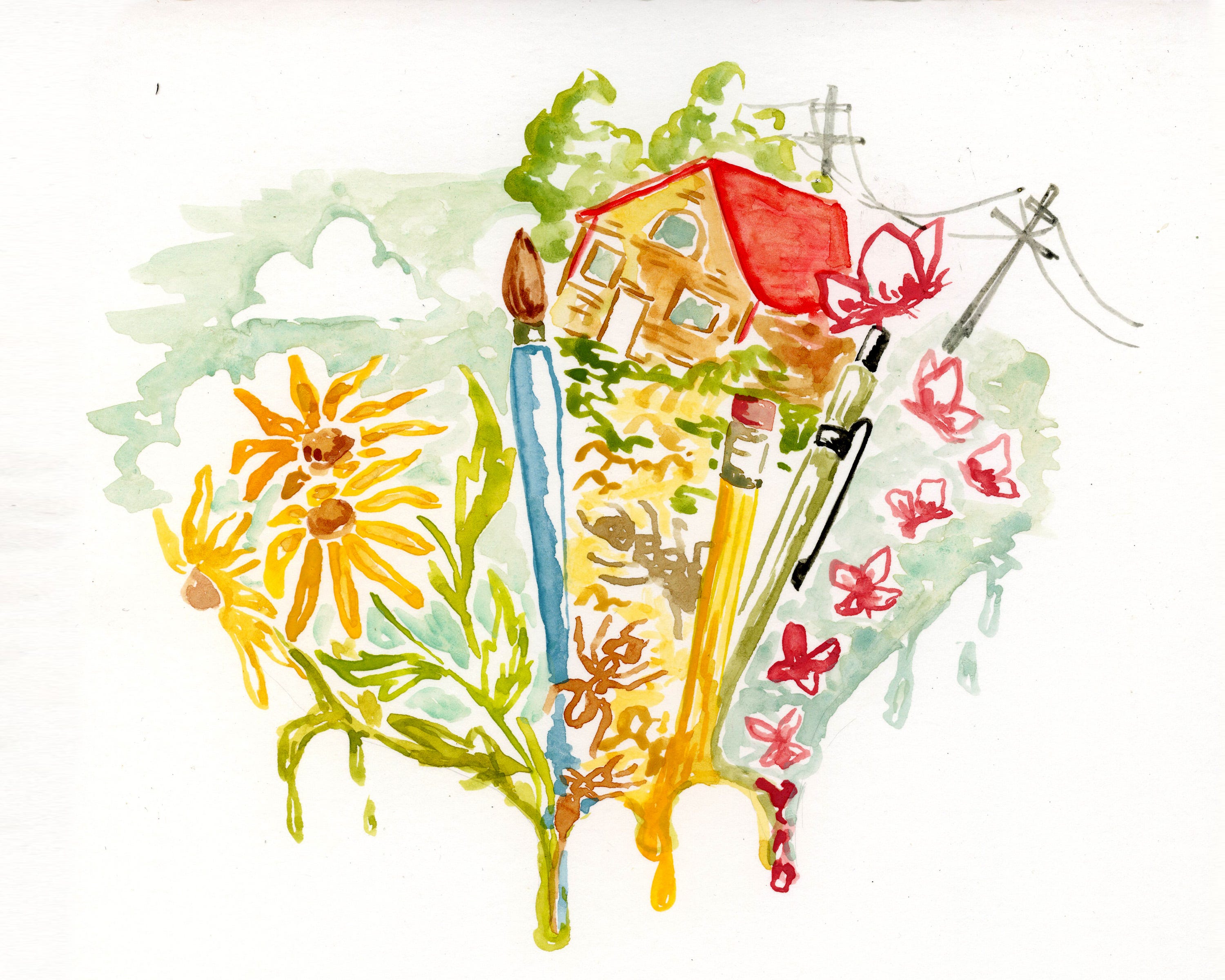
How tech companies steal art and music
AI image generators, such the one used by Substack, are trained on datasets containing billions of copyrighted images, often without the artists’ knowledge, consent or compensation. (A pending lawsuit by artists alleges that nearly half of all images in datasets used to train AI tools such as OpenAI’s Dall-E were protected by copyright law and illegally harvested.)
These models analyze images for patterns, stripping art down to raw material inputs fed to sophisticated algorithms that generate ‘new’ images. Art becomes coal. Music becomes oil.
Molly Crabapple, a writer and artist, calls this: “The greatest art heist in history. Perpetrated by respectable-seeming corporate entities backed by Silicon Valley venture capital.” In 2023, Crabapple gave a speech in which she described encountering AI-generated art with an uncanny resemblance to her own work, later reflecting:
“It was not my work exactly. It was instead a strange facsimile, as if done by a none-too-talented teenager on tranquilisers, all my lines and blotches reduced to rote… AI image generators had scraped my entire body of work off the internet and fed it to their bots, to be excreted out as a product. And it wasn’t just my work; it was everyone’s.”
As for the rest of us, force-fed gallons of AI slop on all corners of the internet, scrolling past heaps of AI garbage on our social media feeds, subjected to the great indignities of generative AI, an irreplaceable feature of our humanity is degraded. Kate Crawford, commenting on “the transformation of human culture into a standard reserve of data,” paints a vivid picture of pig-like tech companies ingesting human art and excreting AI slop. “Everything we’ve created or will create, once digitized, is material for the lots,” she writes.
They’re coming for music too. Many of the songs recommended by our streaming services — often unbeknownst to us (Spotify doesn’t label AI-generated music) – are AI slop. An AI country song called “Walk My Walk” topped the streaming charts; an AI R&B ‘singer’ named Xania Monet landed a million-dollar record deal; a new hit alt-rock band called “Velvet Sundown” was not a band at all.
Even some human musicians (whom I propose we label as traitors) are promoting AI music. Justin Bieber used AI music to soundtrack his Instagram reels; 50 Cent made a video of an AI-music sing-a-long; Young Thug used AI lyrics on a chorus he adapted. There are artist traitors too — OpenAI claims that more than 3,000 visual artists use and help train DALL-E.
It appears that the average listener may not be equipped to discern real music from faux music — a recent study found that 97% of people could not reliably differentiate between the two, and more than half were uncomfortable with that fact.
AI music platforms are also trained on data stolen from musicians and record labels. For a moment, it seemed like the record labels might push back and defend musicians. Warner Music Group sued Suno for stealing its artists’ music, but in a revealing turn of events, Warner settled the lawsuit by entering into a joint venture with Suno. Yes, instead of standing up for its artists, one of the world’s largest record labels decided to side with the music thieves, the very same company that believes “it’s not really enjoyable to make music.”
An earnest plea: As corporate media capitulates to the techno-fascists and welcomes AI into the newsroom, independent journalism has never been more important. I spent five months researching and writing this series (largely unpaid) because I wanted to learn, and writing is how I process information, but I could really use your support.
If you’re able to contribute $5/month, paid subscriptions help sustain this work. As a token of my appreciation, I have a few extra treats that will be sent directly to your inbox. Free subscriptions and sharing with friends are also incredibly helpful, and I appreciate you all!
The AI art and music conspiracy, or, why the elite force-feed us slop
AI-generated music is a direct attack on musicians. It is already extraordinarily difficult to survive as a musician, and now, AI companies flood streaming services with ersatz music that is in direct competition with human art. Spotify, Warner Music Group and Suno are aligned in their intention to churn out efficient slop with minimal human involvement, rather than nurturing beautiful, moving music. A few people get richer; the rest suffer.
Writing in The Nation, Dwayne Monroe compares the degradation of artists’ labor to Fordism: “Through the use of DALL-E as an image production assembly line, the relationship between artist and image is deconstructed and used as raw material — like parts in a Ford assembly plan — for the manufacture of supposedly new images … DALL-E’s employers never have to worry about strikes. Which perhaps is also the point.”
This analysis is at the crux of one half of the AI art conspiracy. Tech CEOs want nothing more than to avoid collaborating with human beings, and especially human artists, whose existence clashes with their misanthropic worldview.
Devaluing artists’ labor is one side of the conspiracy, but the other side is cultural — force-feeding a fraught, anti-human narrative about productivity and convenience. Tech oligarchs want us to believe that synthetic products are actually better than the real deal, simply because they are convenient. Anybody — even this artistically inept author — can type “ant crushes Donald Trump” into an image generation prompt and get a result. We’re being sold a future in which art can be separated from creative thinking, in which art is devoid of learning, difficulty, patience, and friction — which, ultimately, is an art-less future.
Writer and organizer Joshua P. Hill describes AI ‘art’ as a “false luxury.” He writes: “We’re told that one of the world’s great leisures, the pursuit of the arts, is being democratized and made available to us, when instead a hollow and destabilizing imitation is being shoved down our throats, one that cheapens art, and worsens life rather than improving it.”
Many of the most gratifying experiences in life involve struggle. Whether you’re a writer sitting with a notebook and re-writing a paragraph 20 times to order the words just right, or you’re a saxophonist drilling scales six hours a day for 15 years, when we do hard things, we grow. When we struggle, we are changed and, equally importantly, gifted with the ability to change others. This is a deeply human experience — one that is worth fighting for.
From labor struggle to cultural transformation: Ridicule as praxis
If you, like me, wish never to inhabit the dystopia envisioned by tech CEOs, a cultural transformation is necessary. And I’m here to report that it’s already happening.
One famous site of AI-generated art resistance was 2023 the Writers Guild of America strike, when AI usage by Hollywood studios was one of the main points of negotiation. After months of picketing, the writers won a contract that implements guardrails to give workers, rather than bosses, agency over AI implementation.
Speaking about the new contract, comedian Adam Conover said: “We didn’t get bogged down in the science-fiction version. We didn’t protect ourselves against the technology, we protected ourselves against the humans on the other side of the table who are trying to screw us every day.”
While writers, artists, and musicians should indeed be the primary agents deploying new technologies in their fields, and Conover’s assessment of AI as a tool to wage class war is apt, it’s worth going a step further. It’s worth interrogating whether there is also something wrong with the technology itself. Yes, AI corporations and Hollywood studios and record labels and Spotify cannot be trusted (duh), but whether AI-generated art should exist at all is another question.
Asked in 2023 if there is any ethical way to generate AI art, Molly Crabapple answered cogently: “No, there is no ethical way to use AI art from AI Art generators.”
Art reflects humanity in all in contours and colors. When the human is removed from the equation, we are left with a blank canvas, inane images that elucidate no profundity, that add no substance to our culture. Every time we prompt an AI image generator, we move closer to an art-less future.
Crabapple is one of 4,000 artists and writers who signed an open letter calling on artists, publishers, journalists and editors to take a pledge against AI-generated art. Organizing with your fellow craftspeople to develop protections against AI art is certainly one pathway of resistance. But it is not the only meaningful form of action.
A broader cultural shift is necessary to beget mass AI rejection. In the movement’s nascent stage, artists have a leading role in an urgent task: Developing a collective AI intolerance. As the drivers of culture, making art that depicts a dignified vision of humanity antithetical to the cartoonish future projected by tech companies is a form of AI resistance.
This was the analysis of boycott AI actions against NYC subway marketing for an AI-companion called “Friend.” This same analysis is shared by Gareth Watkins in an article he authored about AI and the aesthetics of fascism: “Our most effective weapons against AI, and the right wing that has adopted it, may not be strikes, boycotts or the power of dialectics. They might be replying ‘cringe,’ ‘this sucks,’ and ‘this looks like shit.’”
There are plenty of signs that ‘ridicule as praxis’1 is already working — and costing tech companies billions of dollars. The AI Metaverse, an $80 billion project by Mark Zuckerberg’s company Meta unceremoniously shut down in March. Then, when Meta quietly released a feature in July allowing users to generate AI deepfakes of peoples’ likeness — without their consent — a torrent of public backlash led to the feature’s swift removal. OpenAI also recently pulled the plug on their video-generation business, Sora, despite a massive investment from Disney.2 The reason for such a catastrophic collapse in all these cases? People hated them, and hated them loudly.
Bibliography:
Futurism, “OpenAI Exec Says AI Will Kill Creative Jobs That “Shouldn’t Have Been There in the First Place,” by Frank Landymore. (Source)
The Guardian, “Is AI the greatest art heist in history?” by Molly Crabapple. (Source)
Center for Artistic Inquiry and Reporting, “Restrict AI Illustration from Publishing: An Open Letter.” (Source)
The New Yorker, “That New Hit Song on Spotify? It was made by A.I.,” by Kyle Chayka. (Source)
Artnet, “Artists and Illustrators Are Suing Three A.I. Art Generators for Scraping and ‘Collaging’ Their Work Without Consent,” by Min Chen. (Source)
E-Flux, “Eating the Future: The Metabolic Logic of AI Slop,” by Kate Crawford. (Source)
Deezer Newsroom, “Deezer/Ipsos survey: 97% of people can’t tell the difference between fully AI-generated and human made music – clear desire for transparency and fairness for artists.” (Source)
BBC, “Warner settles lawsuit with AI music firm and launches joint venture,” by Osmond Chia. (Source)
The Nation, “Fordism Comes to the Gallery – and AI Comes for Artists,” by Dwayne Monroe. (Source)
New Means, “Reject AI ‘Art’”by Joshua P. Hill. (Source)
The Guardian, “How Hollywood writers triumphed over AI — and why it matters,” by Dani Anguiano and Lois Beckett. (Source)
“Fuck DALL-E,” by Molly Crabapple. (Source)
Prism, “A burgeoning AI boycott plasters the NYC subway,” by Joseph Mogul. (Source)
The New Socialist, “AI: The New Aesthetics of Fascism,” by Gareth Watkins. (Source)
404media, “Disney’s Sora Disaster Shows AI Will Not Revolutionize Hollywood,” by Jason Koebler. (Source)
A term coined by Alex Hanna, author of The AI Con
And another example: A Chinese company launched an AI video product called “TCL Film Machines” that was touted as a revolutionary disruption of AI in the filmmaking industry… 13 months later its flagship film “Memory Maker” has less than 2,000 views on YouTube (and its comments were turned off).