


This is the second installment of “Ten Reasons to Resist AI: A series of AI explainers for the left,” covering AI and labor. You can read the full series here.
Two-hundred years ago, at the onset of the industrial revolution, one topic animated English pub debates more than any other: automation technology. Would steam-powered looms in the textile industry allow workers to toil more efficiently while creating prosperity among the masses? Or would an emerging class of industrial capitalists leverage automation to disempower laborers, restrict wages and immiserate working class life? Were the machines themselves an existential threat to humanity, or the bosses who implement them?
To this final question, the 19th century Luddite rebellion presented a resounding answer: The bosses were to blame, but as long as automation technology was deployed to benefit the wealthy at the expense of commonality, it must be smashed to pieces.
Today, questions about AI spark analogous debates. While many conversations concern the specter of a sentient, superintelligent, and — crucially — non-existent AI capable of ending humanity, there are still real and present labor implications. To find such political clarity as the Luddites, and wage as vociferous of a resistance, these matters demand our attention: worker displacement, ghost workers, and workplace surveillance.
Worker displacement: Are robots coming for our jobs?
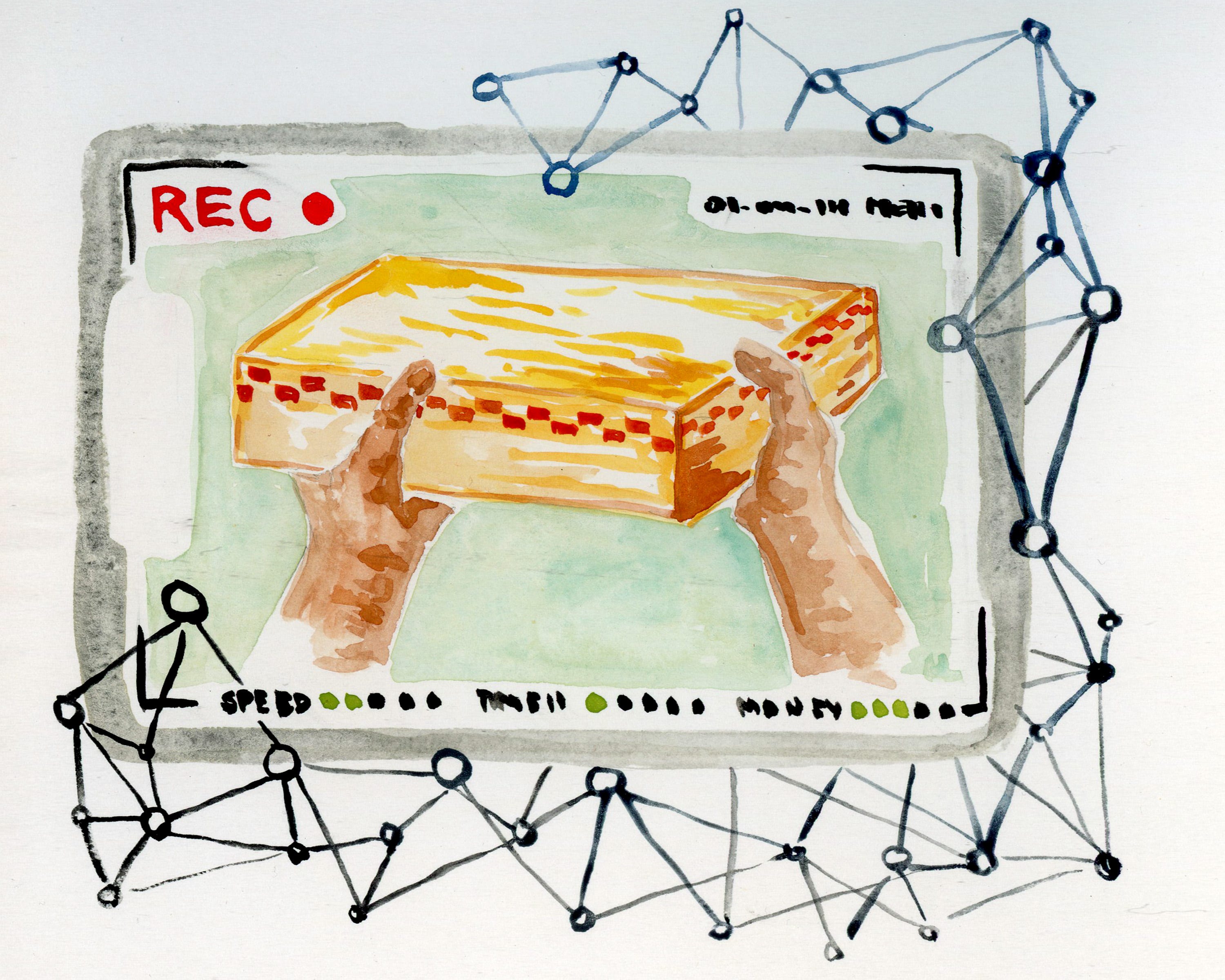
There is no doubt that corporations are already leveraging AI to cut costs, displace workers and bolster profits. Many companies are implementing AI chatbots, agents and data processing systems to replace workers in data entry, customer service and administrative roles. The Bureau of Labor Statistics estimates that over the next decade these jobs will see the largest decrease in employment.
Proponents of AI adoption and big tech sycophants will tell you that now is the time to acquiesce and adapt. One example is a recent Forbes article which presents Bill Ackman (hedge fund owner billionaire), Larry Fink, (BlackRock CEO), and Jamie Dimon (JPMorgan Chase CEO) as sage prophets, heralding the ineluctable AI labor apocalypse with stark predictions of worker replacement.
However, the most dire reports about potential worker displacement should be regarded with a healthy dose of skepticism. For example, Goldman Sachs, a bank with significant investments in the AI industry, published a report claiming that up to half of all jobs will be fully automated by 2045, the kind of claim designed to make AI seem inevitable and resistance hapless. The same companies pushing the narrative of an ‘unstoppable force of AI adoption’ have vested interest in this dystopia’s fruition. They are not reliable narrators.
AI companies also publish their own reports about labor implications. In January, Anthropic, the company behind Claude, authored an “Economic Index.” While it’s full of official-looking charts, a closer look reveals that the methodology relies on unsubstantiated projections and thought experiments. “They just ask other people in the AI industry, ‘do you think that this will be possible at some point?’” said tech writer Jason Koebler on the 404media podcast, “There’s no scientific basis.”
It is revealing that the aforementioned Forbes article concludes with Ackman and Dimon claiming that certain jobs can’t be replaced by AI: specifically, “high-level management,” “strategic leadership,” and “inspiring teams” … also known as CEOs. These billionaires want us to think that our jobs are replaceable, but theirs aren’t. So no, AI isn’t imminently coming for all our jobs — but tech oligarchs will use every tool at their disposal to disempower workers.
An earnest plea: As corporate media capitulates to the techno-fascists and welcomes AI into the newsroom, independent journalism has never been more important. I spent five months researching and writing this series (largely unpaid) because I wanted to learn, and writing is how I process information, but I could really use your support.
If you’re able to contribute $5/month, paid subscriptions help sustain this work. As a token of my appreciation, I have a few extra treats that will be sent directly to your inbox. Free subscriptions and sharing with friends are also incredibly helpful, and I appreciate you all!
Ghost work: out of sight, out of mind
A frequent rebuttal to concerns about the labor impacts of AI is: ‘Sure some workers will be replaced, but jobs will also be created.’ And while some jobs have indeed been created during the AI boom, what these jobs actually consist of goes unsaid. Anthropologist Mary L. Gray and computational social scientist Siddharth Suri coined the phrase “ghost work” to describe the tedious and underpaid labor that corporations disperse to networks of contractors in the Global South, obscuring the true human impacts of their products. “AI systems are fueled by millions of underpaid workers around the world, performing repetitive tasks under precarious labor conditions,” Noema reports.
One example is “Kiwibots,” which are AI delivery robots first launched on UC Berkeley’s campus. The robots seem autonomous, but an investigation revealed that workers in Colombia operate them remotely, each handling up to three robots simultaneously and making less than $2/hour. AI technology supposedly helps the robots stay centered on the sidewalk, but isn’t sophisticated enough to actually operate them. Kiwi Campus, the company behind Kiwibots, calls this “parallel autonomy,” a clever euphemism for “not autonomous.”
One of the more nefarious forms of ghost work in the AI industry is data labeling — a mind-numbingly tedious task necessary to train generative AI models. For example: ChatGPT was trained on trillions of words scraped from the internet, but a significant portion of those words includes the vile, racist, misogynistic, bile found in abundance online. Before ChatGPT could be trained, workers first had to sort through repulsive internet content and flag it as such so that the AI could learn to identify and avoid repeating it.
A Time investigation found that “in its quest to make ChatGPT less toxic, OpenAI used outsourced Kenyan laborers earning less than $2 per hour.” A sizable portion of the data labeled was “pulled from the darkest recesses of the internet,” including graphic descriptions of child sexual abuse, beastiality, murder, suicide, turture, self harm and incest. These Kenyan workers are heavily surveilled, and subjected to strict productivity standards, given less than a minute to label videos depicting extreme violence.
ChatGPT is programmed to not regurgitate such heinous content, but is only capable of doing so because of ghost work done out of sight and out of mind. This labor is outsourced to many different contractors, including a company called Sama that employs workers in Kenya, Uganda and India to label data for several AI companies. When OpenAI asked Sama to sort through not only graphic text, but also images, the workers refused, causing OpenAI to end its contract with Sama.1 (Is now a good time to mention that OpenAI claims to “take the mental health of their employees very seriously.”) Behind every multi-billion generative AI model, behind every ChatGPT query, lies factories full of workers, eyes fixed to the most abominable corners of the internet.
AI worker surveillance
Worker surveillance long predates the advent of AI, but, like all aspects of human life touched by AI, it has supercharged the capacity for bosses to surveil and repress workers.
Amazon is one of the most notorious culprits. Warehouse workers are tracked via AI-powered cameras, subjected to backbreaking paces based on productivity algorithms, and penalized for taking a moment to catch their breath. “Amazon tracks our every move,” Wendy Taylor, an Amazon warehouse worker and union organizer, told The Guardian.
Amazon’s nearly 400,000 delivery drivers are subjected to a network of nine mandatory surveillance technologies that help the company steal wages, while making drivers less safe. (Not all of these technologies are AI-powered, but several are.) Amazon claims this surveillance is a matter of “worker safety,” but a report by Distributed AI Research (DAIR), co-authored by a former Amazon delivery driver, describes how AI tracks and polices employee behavior, while accumulating data to train future AI systems.
The Mentor App is required for all drivers, assigning them an algorithmically-derived “Mentor score” based on data collected from smartphone sensors, including “hard braking, hard stopping, distracted driving or being too close to other cars.” Low Mentor scores can impact a driver’s wage and be cause for firing. But the Mentor app does not account for the real-world chaos of driving a delivery van. For example: A driver might have to stop suddenly to avoid hitting a dog that ran into the street, or might drive through a stop sign after being waved through by a traffic cop. Mentor does not factor in these occurrences — it leaves no room for nuance.
All Amazon delivery vehicles are installed with AI-powered Netradyne cameras on both the exterior and interior. The cameras can listen to drivers’ personal phone conversations, monitor behavior and enforce productivity standards. One of the more dystopian features of these cameras is their real-time AI “coaching” — the cameras speak to drivers and scold them for “distracted driving,” including taking a sip of water. New Amazon drivers are rarely informed that the cameras would speak, often startling them and causing actual unsafe driving, which can lead to lowered Mentor scores and decreased pay.
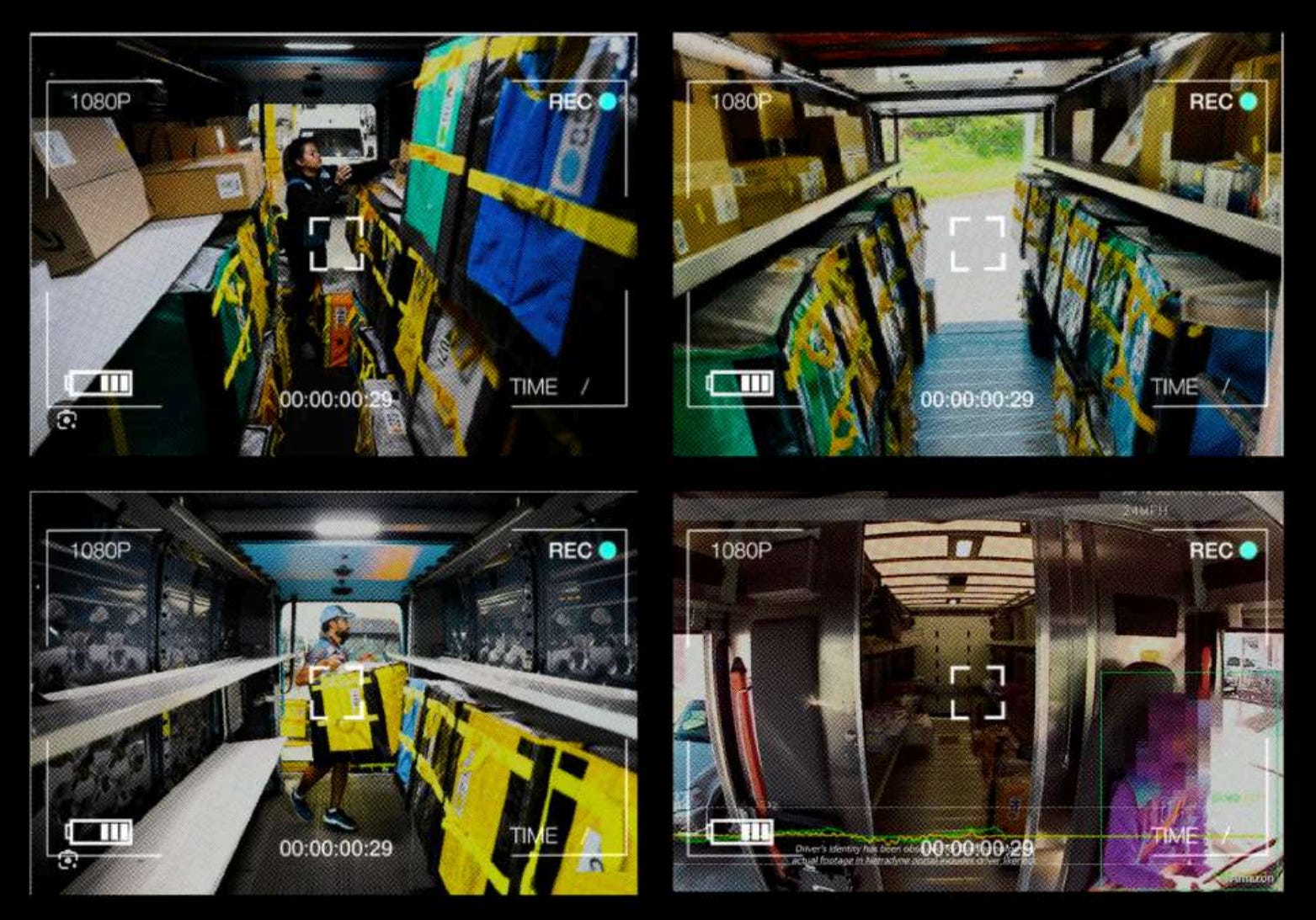
According to DAIR, “It is a poorly-kept secret that Amazon workers are forced to urinate in their vans, due to the inaccessibility of bathrooms on their routes and extreme time constraints.” Netradyne cameras are always running, with no off-button, eliciting shame at having to urinate on camera, with no information about who might be watching.
Many drivers reported that rather than driving as safe as possible, once they figured out what the Mentor and Netradyne algorithms consider to be “good driving behavior,” they would drive in ways that are less safe but the algorithms deem more safe.
Amazon also leverages AI against workers who decide that enough is enough, and start to organize. A report by Northwestern University sociologist, Teke Wiggin, described Amazon’s use of AI to crack down on unionization efforts as “plantation-style management.” The report interrogated how Amazon weaponized AI surveillance technology to influence a union vote in a Bessemer factory. Amazon monitored workers’ social media activity, using an AI that categorized “posts of interest” for a potential investigation, including any that mentioned workers’ complaints or planned strikes. Then, the company used AI to create “unionization risk maps” that track relationships between union organizers at different facilities, a tool to identify defectors and undermine unions. As the union vote approached, Amazon devised a system of “algorithm slack-cutting,” in which factory management loosens productivity quotas in the weeks before a union vote to artificially assuage concerns about workplace safety, only to tighten the algorithms back to their typical back-breaking pace after elections.
Labor is the most important front
Just as the Luddites took up hammers to smash automation machinery, many workers today recognize the threat of AI, not because the technology is inherently evil (though many applications are), but because it is a weapon wielded by corporations to immiserate their lives. Unions are perhaps the most important frontline of resistance to AI. As corporations attempt to introduce AI into more and more industries, more and more workers will have the opportunity to claim the Luddite mantle and organize their workplaces against AI.
In addition to unions that are securing contract protections — such as the Amazon Labor Union and UFCW — worker-organizer groups are forming to combat the encroachment of AI. The Tech Workers Coalition is a worker-led organization building tech labor power in ten U.S. cities and three European countries. They recently launched a website, workersdecide.tech, to share stories and strategies of tech worker resistance, including a guide to union negotiations and “AI implementation bingo.”
Another tool for worker resistance is the “Luddite Lab,” launched in May. The Luddite Lab “provides resources for unions, labor organizations, and worker-organizers fighting AI and automation at work. The lab provides strategies for worker-led governance and oversight of new technology through case studies, primers, and a resource library.” Unionists looking to join the frontline against AI can reference case studies of successful campaigns against AI in the workplace.
In 2022, one of the most historic labor organizing victories of the 21st century occurred in the belly of the beast, an Amazon warehouse in New York City where workers voted to unionize the first Amazon facility in the United States. During a Q&A one year later, former Amazon Labor Union president Chris Smalls was asked about how we can slow the proliferation of AI. He answered: “We have to build power in every industry to slow down that process, to stop them from even thinking about replacing us with machines.”
Bibliography:
Blood in the Machine: The Origins of the Rebellion Against Big Tech, by Brian Merchant. (Source)
U.S. Bureau of Labor Statistics, “Occupations with the largest job declines.” (Source)
Forbes, “These Jobs Will Fall First As AI Takes Over The Workplace,” by Jack Kelly. (Source)
CNBC, “Goldman Sachs says generative A.I. could impact 300 million jobs — here’s which ones,” by Sophie Kiderlin. (Source)
Anthropic “Anthropic Economic Index report: Economic primitives.” (Source)
404media, “AI Job Loss Research Ignores How AI Is Utterly Destroying the Internet,” by Jason Koebler. (Source)
Noema, “The Exploited Labor Behind Artificial Intelligence,” by Adrienne Williams, Milagros Miceli and Timnit Gebru. (Source)
The San Francisco Chronicle, “Kiwi Bots Win Fans at UC Berkeley as they deliver fast food at slow speeds,” by Carolyn Said. (Source)
Time Magazine, “OpenAI Used Kenyan Workers on Less Than $2 Per Hour to Make ChatGPT Less Toxic,” by Billy Perrigo. (Source)
The Guardian, “‘You feel like you’re in prison’: workers claim Amazon’s surveillance violates labor law,” by Michael Sainano. (Source)
Distributed AI Research Institute, “Driven Down: How Workplace Technology Enables Amazon to Steal Wages, Hide Labor, Intensify Poor Working Conditions, and Evade Responsibility.” (Source)
American Sociological Association, “Weaponizing the Workplace: How Algorithmic Management Shaped Amazon’s Antiunion Campaign in Bessemer, Alabama,” by Teke Wiggin. (Source)
Vox, “Leaked: Confidential Amazon memo reveals new software to track unions,” by Jason Del Rey and Shirin Ghaffary. (Source)
Tech Workers Coalition. (Source)
Workersdecide.tech. (Source)
Luddite Lab. (Source)
Meta also contracts Sama to label its Meta Glasses data.
Devastating!