

Unrighteous Rage

Maybe rage is a feeling some people don’t experience. I’m not one of them.
Since moving to New York City I’ve picked up the unseemly habit of being a jerk to cars (see: jaywalking essay). The other day I was biking to the Coney Island Library and during a mile-long stretch of my ride, the bike lane on Neptune Ave was repeatedly clogged with parked cars, forcing me onto treacherous road. The first time this happened I was slightly peeved and the second time solidly frustrated. No big deal, I thought, drawing in a deep breath, I’m sure they were in a rush and couldn’t find anywhere else to park. On I went, carefully gliding in and out of the bike line while dodging incoming traffic. But by the sixth time this happened, I was fully enraged.
I approached a gray minivan parked in the bike lane. Through the side-view mirror I could see a man sitting in the driver’s seat talking on his phone and laughing. He had the audacity to be enjoying himself. Not for long.
There was just enough room to squeeze by him, so I slowed down as I passed, then threw up my hands in exasperation and flashed him a menacing scowl. He wasn’t a fan of that so he responded with a nasty look of his own. That crossed a line–I was clearly in the right and needed to have the last word.
I flipped him off, yelled “GET OUT OF THE BIKE LANE ASSHOLE,” and biked for my life before he had a chance to run me over.
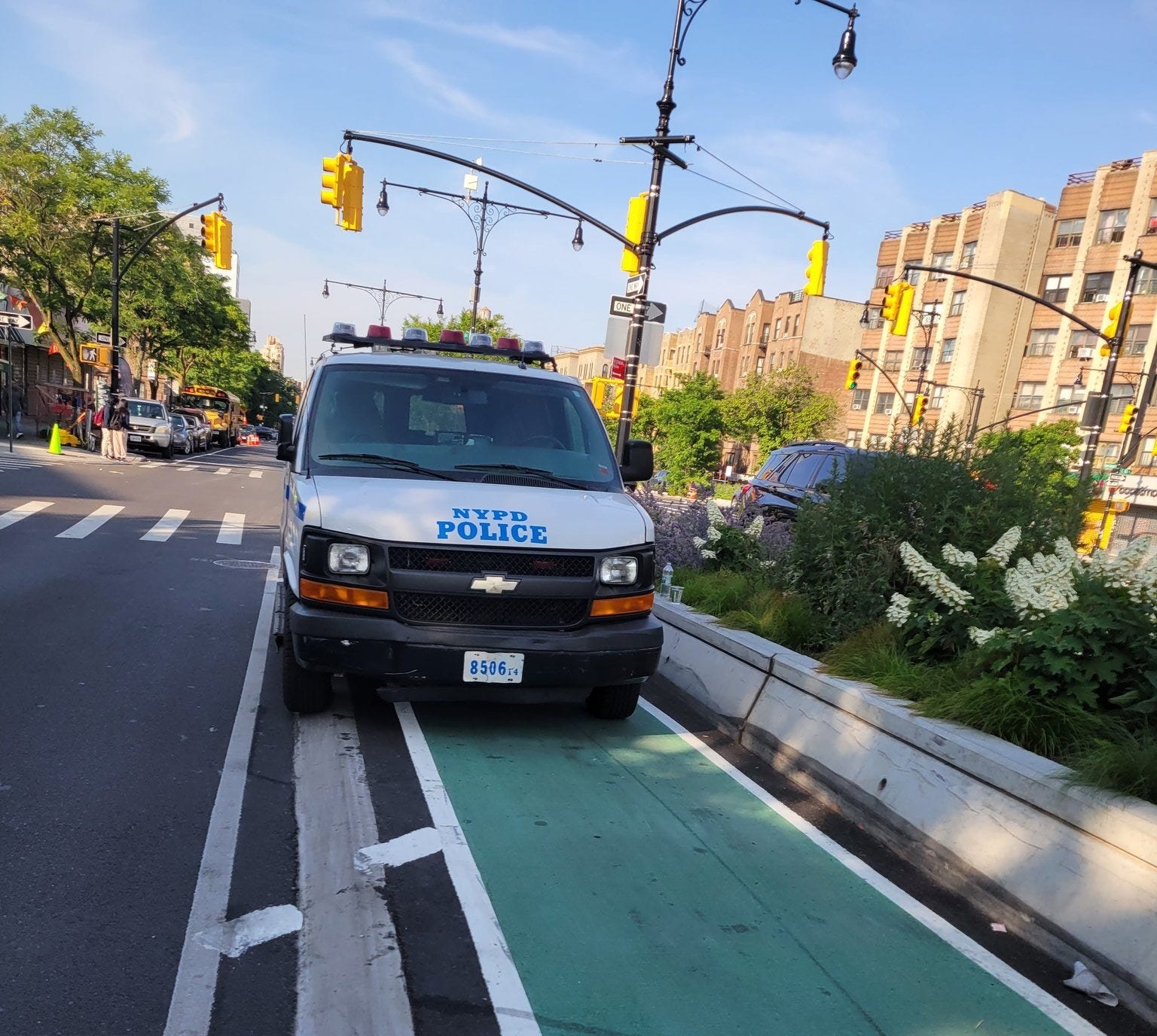
I confess that these antics have become rather ordinary for me. Do I feel good about myself during these fits of rage? Usually for a minute or two. It is undeniably punk-rock to flip off a driver, stare at them with disdain, and then skirt away knowing full well that they could end your life without much effort. Then the adrenaline wears off and I think to myself: what were you thinking idiot, you need a therapist. (Just kidding: you, reader, are my therapist and I wouldn’t dare cheat on you).
Yeah it’s a jerk move to park your car in the bike lane, but reflecting on these moments, my rage isn’t about the individual drivers. What I’m really upset about is the lack of protected bike lanes in NYC, general car-centric city infrastructure, and how people are conditioned to disregard the safety of bikers. On a deeper level, my rage comes from the overwhelming powerlessness I often feel towards our political systems and its insidious tendency to infect the way we treat each other. The powerful-big-bad-driver momentarily becomes a microcosm for all that is bad in the world and the object of my rage.
It might feel cathartic in the moment, but it’s far from productive. It’s not like calling him an asshole was likely to make him less inclined to park in the bike lane next time, or persuade the city to build separated, car-proof bike lines. This was an act of unrighteous rage, meaning it was neither directed towards the root of my frustration, nor designed to influence change.
Sources of alienation and rage are omnipresent in the U.S. (and I suspect elsewhere): ICE kidnaps a mother and her seven-year-old child; a commuter pushes aside an elderly woman on a staircase to dash ahead of her; a routine doctor’s appointment costs hundreds of dollars; an airport water bottle costs eight dollars; taxes fund bombs instead of schools; a car insurance company’s customer service department is exclusively AI agents so we’re put on hold for hours after our car gets stolen (fuck you GEICO).
Of course, not everybody is impacted equally. Racial capitalism by definition grants some lives more value than others. And in a perverse twist of logic, the people who are most marginalized and whose rage is most warranted are granted the least permission to express it. When they do, they are pathologized and criminalized (i.e. the “Perfect Victims” trope).
But even for the relatively privileged, there is much to be upset about. To paraphrase a character from Paul Thomas Anderson’s film, One Battle After Another: The greatest accomplishment of capitalism is perfecting the science of marketing. The other things—those basic human needs we all share (housing, healthcare, food, community)—it’s not so great at providing.
It is politically necessary for this system to misdirect the rage it produces, lest people turn their fury towards capital itself. To this end, unrighteous rage is a politically expedient tool. This is partly a matter of scapegoating: blaming class oppression on immigrants, trans people, Jews, whoever. But it’s more complicated than that, because even for people who know better than to scapegoat, it’s not always clear who is actually to blame. We are often walled off from the true arbiters of power–politicians, lobbyists, think-tank executives, corporate directors, whoever is responsible for NYC bike lanes–but we may have access to individuals at lower rungs of power, or those going about their lives within this broken system.
It’s generally understood that yelling at customer service agents is poor etiquette and flipping off strangers isn’t exactly political action, but what about confronting security guards, workers at weapons plants, or low-level diplomats? Do these people bear responsibility for the systems they help administer? Complicity is often convoluted, therefore legitimate grievance easily veers into unrighteous rage. This is not to say all rage that isn’t directed towards the CEO of Lockheed Martin or President of the United States is “unrighteous.” I would never contend that we should only yell at Kristi Noam and let individual ICE agents be.
There’s been plenty of righteous rage of late towards ICE, including a Chicago biker who made ICE look foolish by breaking their ankles and a woman in New York who responded to ICE intimidation by saying: “Pussy bitch! That’s why ya kids don’t like you! And ya wife is fucking [around] on you!”
Righteous Rage
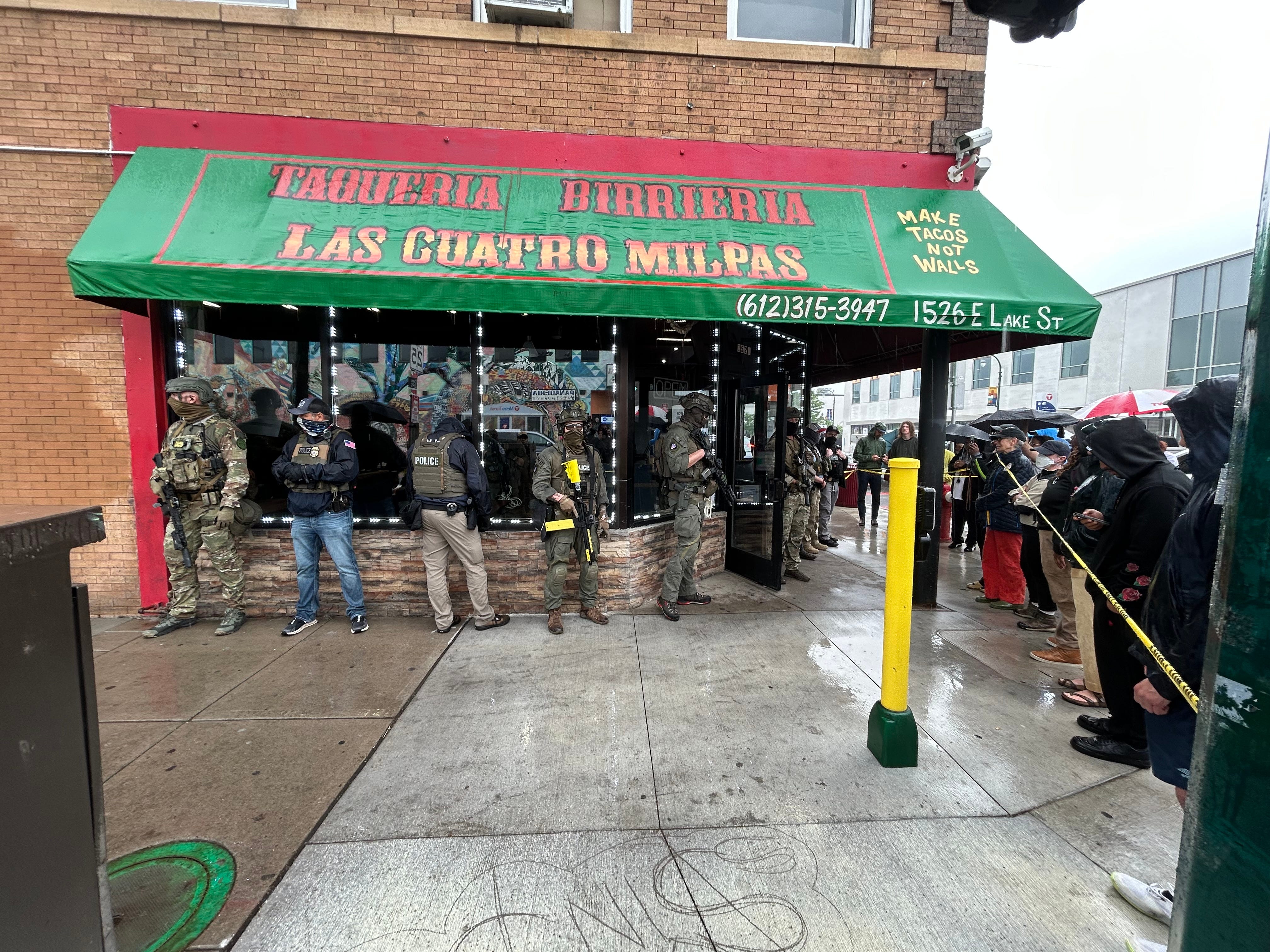
I’ve experienced the fervor of righteous anti-ICE rage myself. On a rainy morning in June, approximately 50 ICE and other federal officers reared their ugly heads at a beloved taco shop in South Minneapolis. An alert went out that ICE had occupied the inside of the restaurant and over a hundred protestors showed up to stop a potential abduction. A tinted black federal van began pulling into an alley behind the restaurant, seemingly to retrieve whoever was inside, and protestors responded by blocking the van. Federal agents threw one person to the ground and arrested her and later deployed pepper spray to disperse the crowd.
People were justifiably furious about the presence of ICE in the heart of Minneapolis’ immigrant community. At one point of the commotion, I hurled a barrage of expletives in the face of a federal agent who was trying to push me back. Something along the lines of: “fuck you you fucking pig fuck go fuck yourself nazi pig.”
The Ingredients of Revolution
Sometimes it is abundantly clear where rage should be directed, and in those moments there is real revolutionary potential. A recent example is Nepal’s September 2025 revolution.
After decades of political corruption and economic inequality in Nepal, a youth movement called Gen Z started using social media to mobilize large anti-government demonstrations. On September 5, the government announced a near-total ban on social media to suppress the budding movement. This was a mistake. The Gen Z-ers were not happy about losing access to social media, and now had nowhere to go but the streets. They called a massive protest outside Nepal’s parliament in Kathmandu three days later. Protestors confronted police, who fired live ammunition into the crowd, killing 20 people.
By the next day, September 9, popular rage had reached a tipping point. Thousands of protesters converged on the parliament building and overwhelmed riot police. They tore down the gates of parliament, broke security cameras, smashed police vehicles with baseball bats, and eventually burnt down parliament. Prime Minister K.P. Sharma Oli was forced to resign. The next day, an interim prime minister was elected (via a discord vote!) and democratic elections are now set for March 5, 2026.
In Nepal (and I posit this stands true through the history of successful revolutionary movements), rage was an incendiary ingredient, but not the only one. In the streets of Kathmandu, there was also a sense of overwhelming possibility, of camaraderie and joy. Amid the chaos, videos show protestors sharing water, laughing, helping each other rinse out tear gas, dancing, and running down newly liberated streets with elation.
Rage can be the tinder for political action when it is harnessed towards its root source (when it is “righteous”), but alone it is insufficient. For rage to manifest in a revolutionary movement, it needs kindling—joy, camaraderie, maybe some strategy, and the belief that a better future is possible.
You can subscribe for free to be notified when I share new writing.
If you’re able to financially support my work, paid subscriptions allows me to keep this going! Free subscriptions and sharing with friends is also helpful and I am appreciative of each and every one of you.
Regarding the topic of the article, it's interesting how a series of minor frustrations can agreggate into something so visceral and unexpected, making us question our own baseline tolerance. What if urban design itself could predict and prevent these conflict points, perhaps using real-time data to dynamically manage street usage and minimize the human friction?
Youre better than me man cuz I will cuss out any driver who endangers my life