

AI and the Compounding Misinformation Crises
Making sense of the media's disastrous AI response

This is the ninth instalment of “Ten Reasons to Resist AI: A series of AI explainers for the left,” covering AI and media/misinformation. You can read the full series here.
My family has a concept called “Moogling,” — a portmanteau of “Googling” and “Mogul” (my last name) — when, in the middle of a conversation, somebody says something you think may be inaccurate, so you pull out your phone to fact-check them in real time. (Yes, we’re insufferable people.) I was recently Moogled while explaining Palantir kill lists to a relative, who promptly consulted her phone to verify this shocking information. “Well according to Google Gemini AI…”
Information, it seems, is being sourced more frequently than ever from generative AI systems. The developers of these AI systems are tech companies owned by the richest people in the world, many of them also owners of the largest legacy and social media corporations.
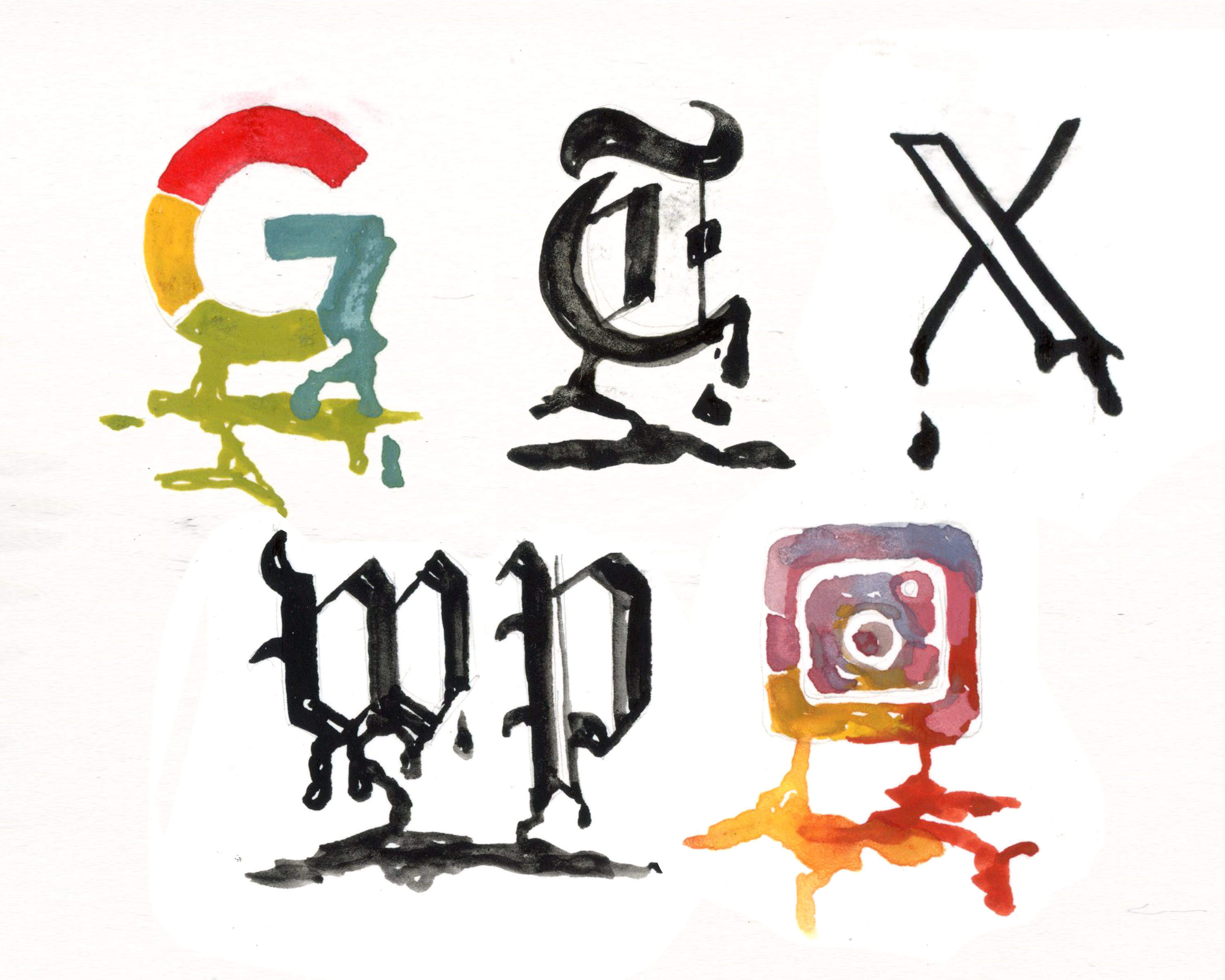
Beyond soiling a time-honored family tradition, AI is fundamentally altering the information ecosystem. Social media companies opening the floodgates for AI deepfakes are eroding our ability to discern truth from hogwash. Media conglomerates are inviting AI into the newsroom, inking deals with tech companies to automate crucial aspects of journalism.
The Slopapocalypse
There are some recent examples of outlandish AI-generated content disseminating far and wide on social media, referred to as “AI slop.” During the 2026 U.S.-Israeli war on Iran, social media was deluged with Iranian-made AI music videos featuring Donald Trump and other U.S. officials as lego characters acting like blood-thirsty pedophiles. The White House clapped back with its own AI memes. On the domestic front, amid a feud with Pope Leo, Donald Trump tweeted an AI portrait depicting himself as Jesus Christ.
Jesus Christ!
While AI propaganda is sometimes ridiculous enough to be relegated to the realm of slop, more discreet AI deepfakes are also starting to proliferate. A deepfake is a piece of media, often created with AI, that is meant to deceive the public by fabricating the likeness of real people, places or events. Done effectively, deepfakes can be close to indistinguishable from real media content.
When Israel started its unprovoked war on Iran in June 2025 (later joined by the U.S.), Iran returned fire both with missile strikes and with AI propaganda. Iranian accounts shared widely-circulated AI-generated deepfakes on Twitter, greatly exaggerating the impact of Iranian strikes on Israeli targets. One video, viewed 27 million times, showed dozens of missiles landing in the middle of Tel Aviv.
Israel responded with its own AI propaganda. The IDF reposted AI-generated videos of missile strikes and fabricated clips of mass protests in Iran, bolstering the false narrative of an imminent uprising against the Iranian state. In one AI-generated video, demonstrators march through Tehran chanting “we love Israel,” — a telltale sign of deception.
Some Twitter users pointed out the signs that these viral videos were indeed fake. Others asked Grok, Twitter’s AI chatbot, to verify them; Grok repeatedly claimed that AI videos were real, adding to the confusion.
During Russia’s invasion of Ukraine, Russian operatives released a deepfake video depicting President Zelensky urging Ukrainians to lay down their weapons and surrender. While the precise impact of this attempted sabotage is unknown, it’s clear that authoritarian governments are increasingly using AI as a mechanism to obscure the truth during times of war.
Another government agency that has benefited from AI deepfakes is ICE. During the federal occupation of Minneapolis, organizers relied on Instagram to disseminate information about rapidly shifting conditions on the ground. This opened the door to click-farming Instagram accounts to spam AI videos showing fake confrontations between ICE and protesters. Within hours of ICE murdering Renee Good, one AI-slop account posted over 50 AI-generated videos. Some videos showed protesters slapping ICE and dousing officers in gasoline; others depicted local police arresting federal agents. (Instagram does not require users to label AI-generated content.)
Using AI to distort reality and sow confusion is a potent tool of fascism. In addition to obscuring the truth through the spread of fake images and videos, it also enables government officials to claim that real media is actually fake. Law professors Bobby Chesney and Danielle Citron coined the phrase “the liar’s dividend” to describe this phenomenon, allowing powerful officials to elide the truth and shirk accountability when there is overwhelming evidence of wrongdoing.1
Before AI slop and deepfakes took over social media, the unregulated proliferation of misinformation on social media was already a grave problem — over half of U.S. adults get their news on these platforms. But now AI-powered misinformation is exacerbating a misinformation crisis.
The solution to misinformation, of course, is a steadfast, reliable media ecosystem to which people can turn when they read or see something absurd online. And yet, trust in the media is at an all-time low. Sometimes this mistrust comes from a fascist impulse — as is the case when Donald Trump says that media organizations are the “enemy of the people,” launching baseless lawsuits against media conglomerates. (Many of these companies are vying for consolidation deals and are eager to appease the Trump administration.) Other times, mistrust stems from a legitimate grievance of media companies weaponizing passive voice against Black victims of police murder or brown victims of genocide, a product of the unspoken though everpresent allegiance between corporate media and capital.
We are facing compounding crises: a torrent of AI slop on social media, an unregulated digital information ecosystem, a distrustful public, and a fascist government obfuscating our shared reality.
Good journalism has never been more important. Now is the time for the media to step up the plate, re-assert the fundamental tenets of their work — speaking truth to power, uplifting marginalized voices — and restore their public credibility. But they are striking out spectacularly. Corporate media is not only capitulating to the Trump administration in courtrooms and editorial boardrooms, but also to the tech industry and its narrative of AI inevitability.
An earnest plea: As corporate media capitulates to the techno-fascists and welcomes AI into the newsroom, independent journalism has never been more important. I spent five months researching and writing this series (largely unpaid) because I wanted to learn, and writing is how I process information, but I could really use your support.
Corporate media embraces AI
In 2024, Nilay Patel, editor-in-chief of The Verge (part of Vox Media) coined the phrase “Google Zero” to describe a doomsday scenario in which AI renders search engine traffic obsolete.
“If AI chatbots and AI-powered search results are summarizing everything for you, why would you go to a website?” Patel wrote. “And if we all stop going to websites, what’s the incentive to put new content on the web? What’s going to stop shady characters from flooding the web with AI-generated spam to try and game these systems? And if we succeed in choking the web with AI, what are all these bots going to summarize when people ask them questions?”
Google Zero foretold a strategy of tech companies expanding the reach of AI chatbots while restricting other information sources, until generative AI achieved complete ubiquity. The impact of this encroachment would be the end of digital traffic and a massive hit to corporate media’s web advertising business model. This prophecy was not supported by the desires of the masses — in fact, a recent poll found that less than 1 percent of Americans prefer getting their news from AI. But Big Tech has been unrelenting, and internet search engine behemoth Google continuously demoted news sites in favor of its “AI Overview” and sponsored pages.
How would corporate media survive such a dire predicament? Their answer, it seems, was to join forces with AI companies, embracing a future of automated news.
Condé Nast, parent company of The New Yorker, inked a licensing deal with OpenAI in August 2024, joining an expanding list of outlets that now includes the Associated Press, Vox Media, the Wall Street Journal, Time Magazine, The Atlantic, Le Monde and the New York Post. These media companies license their intellectual property to ChatGPT, allowing it to display their stories to users. On the surface, these deals may seem benign, if not beneficial: Why shouldn’t generative AI chatbots reference verified news sources?
For one, the details of these deals are kept secret and there is reason to believe that OpenAI is training ChatGPT on these licensed articles without the consent of the journalists who write them. But these business partnerships also set a precedent of AI media capture, further entrenching the leading role of tech oligarchs dictating the flow of public information. Tech companies are famously discontent with getting one foot in the door. They tend to push hard until the entire body of an industry — whether media, entertainment or art — is within their grasp. And once they’ve entered a new industry, they start rolling out their AI products, diluting the quality of journalism for the rest of us.
The Washington Post — owned by Jeff Bezos — recently launched a new AI tool called “Ember,” an AI-writing coach for op-ed contributors to more efficiently churn out pro-capitalist op-eds with fewer pesky humans involved. This comes as the Post lays off one-third of its workforce.
Ember is just one example of AI unleashed in the newsroom — other outlets are taking things a step further. The Baltimore Sun publishes political analysis using generative AI. The paper’s February 13 issue featured two AI-generated articles: one about a speech by Governor Wes Moore and another about a feud between him and Trump.
Some individual journalists are also embracing AI, denigrating their own labor. Nick Lichtenberg, an editor at Fortune, is the most stark example: He has “written” over 600 stories with generative AI, as many as seven in one day. According to the Wall Street Journal, AI-generated stories accounted for about 20% of Fortune’s internet traffic, most of which were written by Lichtenberg. His methodology consists of uploading government and corporate press releases to generative AI which spits out articles that he gives a light edit and hits publish — the kind of thing any rag can do. In some ways, it makes total sense that corporate media would find this acceptable: Lichtenberg saves them a dime by automating the process, becoming the ultimate stenographer for the state.
Other journalists have a more neutral perspective, denouncing Lichtenberg-style plagiarism while insisting that AI has the potential to transform media for the better. New Yorker writer Joshua Rothman recently penned an article about his experimentation with AI tools such as ChatGPT, testing how they impacted his news consumption. He writes, “Using AI to catch up can be great. Imagine asking the Times what happened in Ukraine while you were on vacation, or instructing The New Yorker to recap the first half of that long article you started last week.” He also used ChatGPT as a research tool, which he claimed was helpful in sourcing historical information outside the scope of the news cycle.
After commenting on the quirks of these technologies — such as its habit to share different results based on slight nuances in a users’ query — Rothman’s article concludes: “I asked, and asked, and asked. Then, in the traditional way, I read, and read, and read. It was a helpful combination, I thought. It seemed to me that AI could improve the news—if it doesn’t destroy it in the process.”
Rothman’s argument — and the implicit conceit of all AI newsroom usage — is that we can “optimize” media consumption and production, the same way one might “optimize” their body with weight loss drugs or “optimize” their Sunday morning by asking ChatGPT to plan it for them. We might question whether AI is truly “optimizing” journalism and if “optimization” is truly a desirable outcome.
To the first point, while generative AI tools can produce instant responses to complex queries, studies have shown wild inaccuracies in results. A recent book by a journalist named Steven Rosenbaum called The Future of Truth: How AI Reshapes Reality was revealed to have been written with AI assistance and contains many “hallucinations,” in which fake quotes were attributed to real humans. Gemini AI has a 10% inaccuracy rate and tells approximately ten million lies every hour. And while I concede that perhaps AI technology may improve over time to the point where it is as reliable as a standard search engine, there are still other factors to consider, such as whether eliminating humans from the equation is truly “optimal.”
I happen to work as a journalist and have gotten a look under the hood of media production. And let me tell you, throughout the editorial process, everybody involved is making constant political decisions: Whose voices do we include? How much space do we give them? How do we frame their perspective? Which sources are considered reliable? What stories are we telling in the first place? Pretending that AI can mitigate human fallibility and create a more objective process is fictitious. As we’ve covered, algorithms are magnified reflections of our own biases. When a media company decides to let AI systems loose, it will be at the discretion of the tech companies that program them. And the last thing we need in the media right now is more involvement from tech oligarchs.
Today, AI is not helping the media get it right or restoring its tarnished reputation. Instead, it is a scheme for media conglomerates to remove humans from the equation and squeeze out additional profits. Let us hope we never inhabit a world where AI-generated bylines are regarded as more veracious than human-written ones.
Taking back the media
The editors of Truthout — an independent movement media publication that I write for — recently published an article outlining the devastating impact of AI on its readership.
“The sudden shift in Google Search presents us with a pointed question, not only about journalism, but about the future of humanity: How much of our autonomy will we cede to AI? To what extent will we adopt an “oh well!” mentality? Or will we seek creative ways to resist, even when it may feel impossible to confront the largest corporations on the planet?” the editors write.
Dear readers, I ask that you refrain from using generative AI to read up on the news, that you instead read and support the plethora of independent news outlets out there. Journalists can choose to abstain too, and to organize with their fellow workers. Unionized journalists across the U.S. are campaigning under the banner “News Not Slop” to defend their work from “media companies implementing artificial intelligence in ways that damage the credibility of journalism.”
And while pushing back against vampiric tech companies encroaching on the media industry is necessary, it is just the tip of the iceberg. Resisting AI in the media and tackling rampant misinformation will require transforming the media landscape and taking back ownership from oligarchs. That is where the true solution lies: independence from corporate capture. Like so many of the impacts and applications of AI that we have covered, AI is not the root cause of misinformation or the faltering media ecosystem — it is simply a compounding factor in the many crises of capitalism. We resist the “AI takeover” by subverting capitalism, whether it’s by building alternative media outlets or through labor organizing.
Bibliography:
404media, “Iran Is Winning the AI Slop Propaganda War,” by Matthew Gault. (Source)
BBC, “Israel-Iran conflict unleashes wave of AI disinformation,” by Matt Murphy, Olga Robinson and Shayan Sardarizadeh. (Source)
Northwestern Buffett Brief, “The Rise of Artificial Intelligence and Deepfakes.” (Source)
NBC News, “AI-altered photos and videos of Minneapolis shootings blur reality,” by Jared Perlo, Marin Scott and Bruna Horvath. (Source)
Brennan Center for Justice, “Deepfakes, Elections, and Shrinking the Liar’s Dividend,” by Josh A. Goldstein and Andrew Lohn. (Source)
Pew Research Center, “Social Media and News Fact Sheet.” (Source)
Gallup, “Trust in Media at New Low of 28% in U.S,” by Megan Brenan. (Source)
The Verge, “Google CEO Sundar Pichai on AI-powered search and the future of the web,” by Nilay Patel. (Source)
Observer, “OpenAI’s Media Partnerships Continue to Grow, Strikes Deal With Condé Nast,” by Alexandra Tremayne-Pengelly. (Source)
The Atlantic, “Will The Washington Post Embrace the AI Slush Pile?” by Amanda Katz. (Source)
The Objective, “When The Baltimore Sun can’t get journalists to lower their standards, it turns to generative AI,” by Madisyn Parisi. (Source)
The Wall Street Journal, “An AI Upheaval Is Coming for Media. This Journalist Is Already All In,” by Isabella Simonetti. (Source)
The New Yorker, “Will AI Save the News,” by Joshua Rothman. (Source)
ARS Technica, “Testing suggests Google’s AI Overviews tell millions of lies per hour,” by Ryan Whitwam. (Source)
Truthout, “Google’s New AI-Fueled Search Bar Threatens to Further Upend Journalism Industry,” by Negin Owliaei , Maya Schenwar , Ziggy West Jeffery. (Source)
Fans of the TV show The Boys will be familiar with this if they’ve seen the opening scene of Season 5.
Slopapocalypse! Love it.